
Demon Hunter Rivals (Cancelled)
Timeline
December 2025 - January 2026; 1 Month
My Role
Communication
I was responsible for creating the UI for an indie game developer producing a 3v3 anime themed fighting game using the Roblox game engine. I iterated on existing assets and created new ones with the assistance with the solo developer.
Discord Messages and Calls
Overview
Demon Hunter Rivals was a free-to-play video game in early development made within the Roblox game engine. The concept was similar to products like Marvel Rivals and other hero video games while having gacha elements to keep users playing. Unfortunately, it was cancelled due to the main developer stating “project feasibility” issues.
Objective
To advance video game development on a product within it’s early phases.
First Steps (December 22)
On December 22 2025, the solo developer of the project (Nick), contacted me on Discord to ask if I would be interested in assisting in the development of a video game he has been making for a few weeks at that point. I agreed and we began official development on December 29, 2025.
To get me caught up with the project, the developer shared a Figma file with the existing assets. We spoke for about an hour and discussed what his vision was for his video game. We agreed that I would work on developing the Lo-Fi screens first in order to set a foundation and shared understanding for the product. You can see some of the earliest screens the project had when I joined the project below.
Main screen players would see when in the waiting lobby. NOTE: The in-game currency, buttons at the bottom, and random gacha spin indicators.
Another customize screen where players would be able to use in-game currency or lucky rolls to acquire new skills to be used during gameplay.
Customize screen where players would be able to use an in-game currency or lucky rolls to acquire characters to play.
After the holidays, I began work on developing my own version of the screens the developer requested. As seen below, I iterated on the following screens: Matchmaking, Personas, and Character Abilities. The reason why I did not stick with the fidelity for the Persona and Ability screens is due to the developer allowing me to start fresh while using the original designs as inspiration.
When the players click “Play”, this is the screen that would pop up to allow them to choose the side they wish to play on by pressing “Join”.
Development Continues (Jan. 1-5)
Iterated Matchmaking Version
Original Matchmaking Version
Iterated Personas Version
Iterated Abilities Version 1
Original Personas Version
Original Abilities Version
Early Settings Screen
Iterated Abilities Version 2
At the same time, I was also given permission to begin the development of screens that did not exist but were needed to start building the idea of how the video game would look. So I took some time before my next meeting with the developer to build the Lo-Fi wireframes of the settings and stats screens.
Early Stat Tracking Screen; NOTE:
During this period of time of development, the developer and I were having weekly meetings unless there was a misunderstanding or urgent change that needed to be made to the designs. So after the first week, the developer and I took time to ensure the deliverables were aligned with the product’s vision and to see which screens needed more work before I could move on.
The first misunderstanding was
Forward Progress (Jan. 6)
After the meeting, we were able to clear up specific misunderstandings in the designs but the developer requested for an iterated set of screens based on comments and live edits made during the session. My goal when making these iterations is to keep the developer informed on possible issues and to provide solutions to fit within the vision while keeping the user experience in mind. Specifically, for the Stats screen, I studied stat tracking systems from other games such as Marvel Rivals to get inspiration while designing.
Original Persona Design
Original Abilities Design
Original Matchmaking Design
Original Stats Design
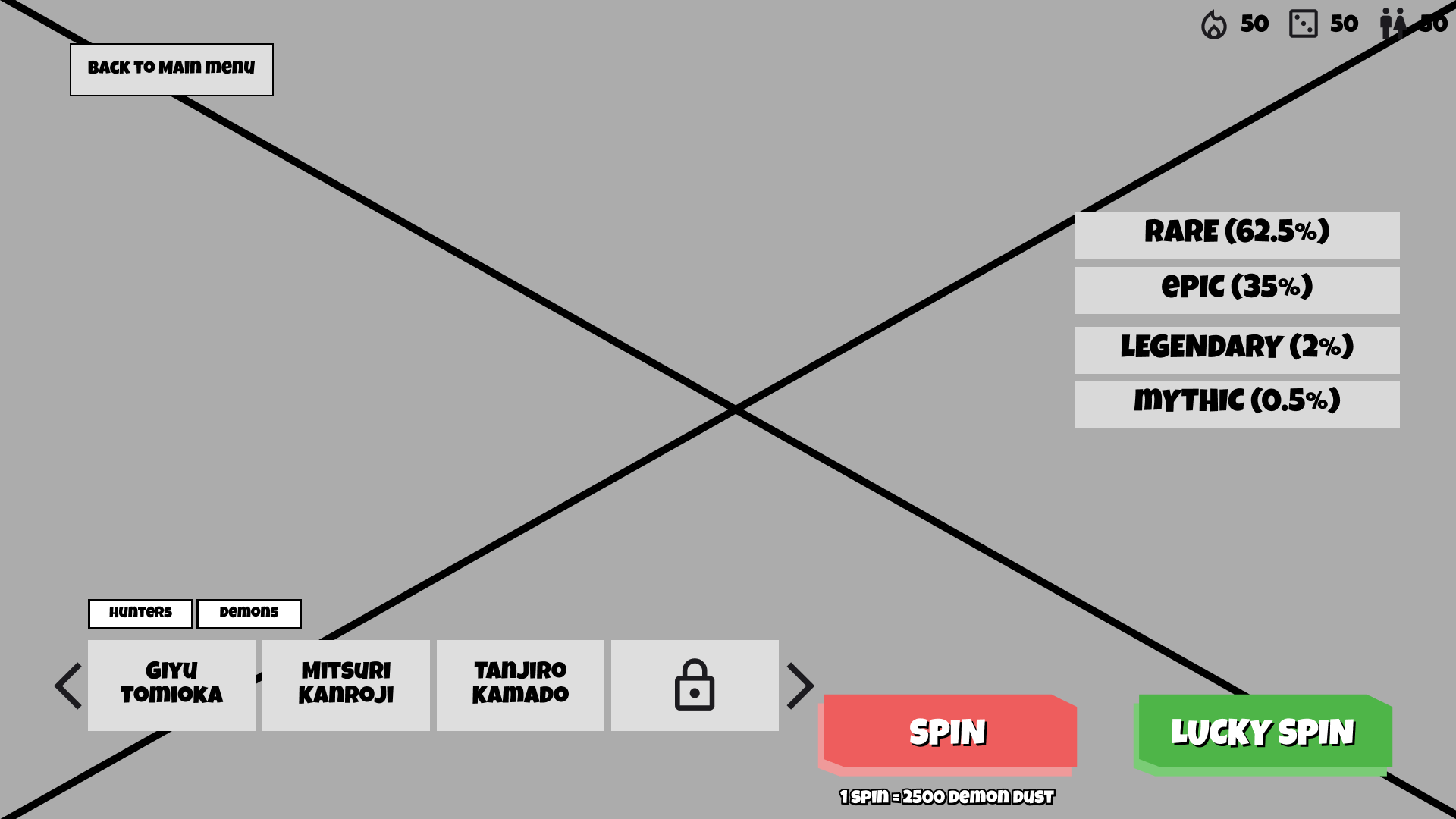
Iterated Persona Design
Additions: Gacha percentage rates and Lucky/Normal Persona roll indicators, “Techniques” button to allow users to switch customization screens
Changes: In-Game Currency (Demon Dust) location and icon, “Back to Main Menu” button
Iterated Abilities Design
Additions: Gacha percentage rates and Lucky/Normal Abilities roll indicators, “Technique” box holding name of the ability, “Persona” button to allow users to switch customization screens
Changes: Lowered Abilities Count 2 → 1 due to developer input, Moved abilities explanation text bottom center, “Back to Main Menu” button
Iterated Matchmaking Design
Changes: “Back to Main Menu” button
Iterated Stats Design
Additions: Added “Play Time”, “Kills”, and “Experience Level” columns, Prestige Rank
Changes: Removed the “Overall” tab
Prepping for Mid-Fi Transition (Jan. 8-23)
Once we agreed on the new iterations, I was given the approval to begin developing the screens where users would be able to purchase in-game currency for “Lucky Rolls” and “Demon Dust”. I also started to develop some mid fidelity deliverables (icons and buttons) to replace the placeholders and to begin the transition into the next step of development. The reason for the long period between deliverables was due to work and other obligations that required my attention at the time. But I still worked on the following deliverables during the period of time and asked questions when I could to ensure project alignment.
End of Development (Jan. 26)
Before we had the chance to transition from low-fi to mid-fi wireframes, the developer informed me that he had made the decision to end production on the project, citing the growing scope of the work as the primary factor. With development brought to a close, the design work concluded at this stage as well, marking the end of the collaboration.
Reflection
This was a fun project to work on. It allowed me to gain experience and insight on the indie game development process. Even though the project was not able to get past the Mid-Fi phase, I grew as a designer and a professional.
The team that I joined consisted of only myself and the developer. So, as a result, I did not have any other designers to bounce ideas off of. Instead, I leaned heavily into being comfortable working through ambiguity and making sure each meeting I have with the developer is as constructive as possible to ensure project alignment.
If given the opportunity, I would like to improve the following:
Document meetings. Transcribing or taking detailed notes during meetings would give me a clearer reference point when designing afterward.
Continue advocating for the user. When collaborating with other team members, I want to keep upholding an environment where everyone feels heard while still keeping the user's needs at the center of the conversation.
Learn to speak the developer's language. This experience reinforced how important it is for team members to understand the tools each other uses. Not to the point of expertise, but enough to communicate effectively throughout development.